
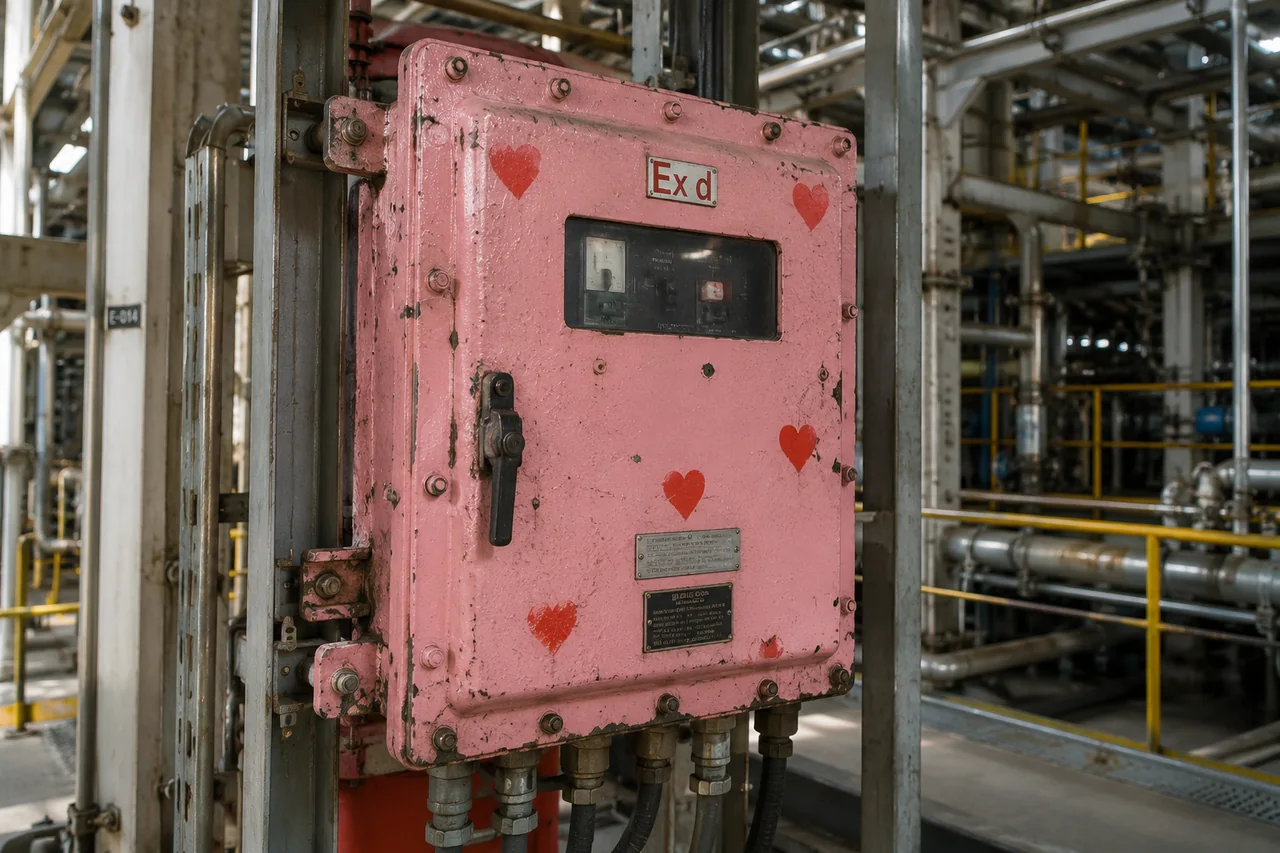
May an Ex d enclosure be sanded and repainted?
An Ex d enclosure has been installed outdoors for many years and has started to corrode.
At first sight, the solution appears simple: remove the corrosion, sand the surface, apply a new primer and finish it with a durable industrial coating. The installation looks almost new again.
But is this permitted?
In practice, opinions on this subject vary considerably.
Some argue that a new paint layer is merely cosmetic and therefore has no influence on explosion safety. Others take the view that any work carried out on an Ex d enclosure constitutes repair or modification and must therefore be reassessed.
The reality is more nuanced.
For an Ex d enclosure, the essential issue is the flameproof joints, often referred to as flamepaths. These precisely machined surfaces are designed to prevent an internal explosion from propagating to the surrounding explosive atmosphere. Their dimensions, surface finish, clearances and mechanical fit form part of the type examination and therefore part of the certification basis.
If these flamepaths are sanded, grit-blasted, filled, machined, coated or otherwise treated, their characteristics may be changed. In that case, it can no longer simply be assumed that the enclosure still complies with the design assumptions on which its Ex certification was based.
But what about the outside of the enclosure?
A corrosion-protective coating on surfaces that do not form part of the flamepath may, under certain conditions, be acceptable. The manufacturer's instructions are decisive. Some manufacturers specify exactly which coating systems may be used, what maximum coating thickness is permitted and which areas must never be treated. Other manufacturers prohibit any surface treatment without their prior approval.
This is precisely where things often go wrong in practice.
During inspections, I regularly come across Ex d enclosures that have been completely overpainted. Not infrequently, bolt heads, nameplates, earthing points, threaded entries and even flamepaths have been covered with a thick layer of paint. The installation may look well maintained, but the real question is whether explosion safety has actually been improved.
Explosion safety is not determined by how good an installation looks. It is determined by whether the certified construction has remained unchanged and whether the equipment is still suitable for use in the hazardous area.
A new coating may extend the service life of an enclosure. However, if components that are essential to the flameproof construction are treated incorrectly, a well-intended maintenance activity may create a deviation from the certification basis.
Good maintenance therefore does not start with a paint sprayer. It starts with one simple question:
What does the manufacturer's documentation say?
Ultimately, it is not the colour of the enclosure that determines explosion safety, but the preservation of the characteristics on which the Ex certification is based.
UK and European regulatory context
In the United Kingdom, the use and maintenance of equipment in potentially explosive atmospheres must be considered in relation to DSEAR, the Dangerous Substances and Explosive Atmospheres Regulations 2002, together with the Health and Safety at Work etc. Act 1974, the Management of Health and Safety at Work Regulations 1999 and the Provision and Use of Work Equipment Regulations 1998. Equipment placed on the UK market is subject to the Equipment and Protective Systems Intended for Use in Potentially Explosive Atmospheres Regulations 2016, as amended.
Within the European Union, the relevant framework remains Directive 1999/92/EC, often referred to as ATEX 153, for the protection of workers, and Directive 2014/34/EU, often referred to as ATEX 114, for equipment and protective systems intended for use in potentially explosive atmospheres.
Sources
- BS EN IEC 60079-17:2024 / EN IEC 60079-17:2024 - Explosive atmospheres - Part 17: Electrical installations inspection and maintenance.
- BS EN IEC 60079-19:2020 / EN IEC 60079-19:2019 - Explosive atmospheres - Part 19: Equipment repair, overhaul and reclamation.
- IEC 60079-0:2024 - Explosive atmospheres - Part 0: Equipment - General requirements.
- IEC 60079-1:2024 - Explosive atmospheres - Part 1: Equipment protection by flameproof enclosures "d".
- DSEAR 2002 - Dangerous Substances and Explosive Atmospheres Regulations 2002.
- Equipment and Protective Systems Intended for Use in Potentially Explosive Atmospheres Regulations 2016, as amended.
- Directive 1999/92/EC and Directive 2014/34/EU.
- Manufacturer's instructions, certificates, drawings and maintenance documentation for the specific Ex d equipment.
https://exquintia.com
Hashtags
#ATEX #IEC60079 #Exd #ExplosionProof #ExplosionSafety #DSEAR #HazardousAreas #Inspection #Maintenance #Corrosion #ProcessSafety #IECEx #AssetIntegrity #IndustrialSafety #Exquintia