
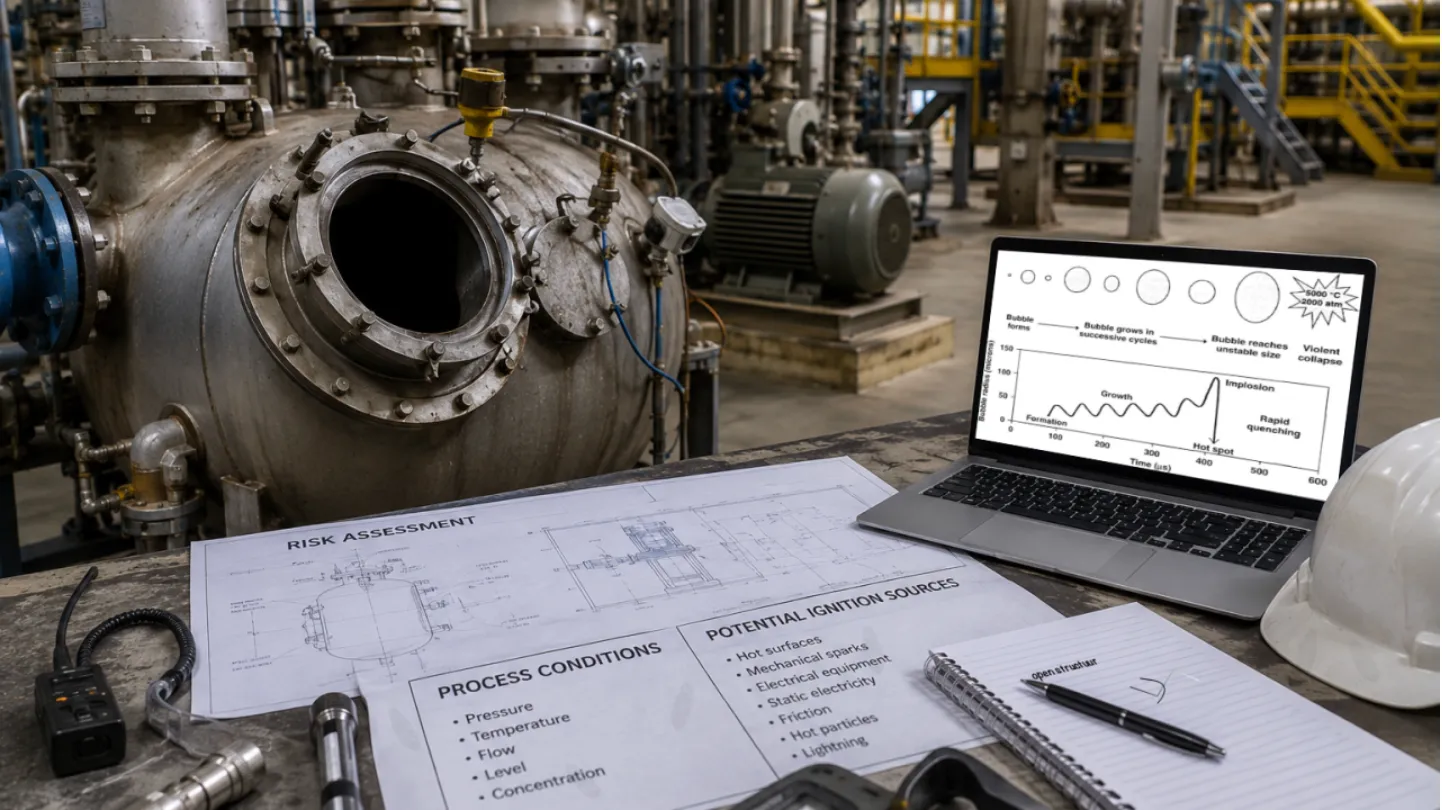
The greatest explosion risks are often not shown on the hazardous area classification drawing
In many organisations, considerable attention is given to external hazardous area classification. Drawings are updated, Ex equipment is selected and inspections are carried out in accordance with the applicable standards and regulations.
That is necessary. In Europe, ATEX Directive 1999/92/EC requires employers to assess and control risks from explosive atmospheres, while ATEX Directive 2014/34/EU sets the requirements for equipment and protective systems intended for use in potentially explosive atmospheres. In the United Kingdom, the same operational duty is mainly reflected in DSEAR, the Dangerous Substances and Explosive Atmospheres Regulations 2002, while equipment placed on the Great Britain market is covered by the Equipment and Protective Systems Intended for Use in Potentially Explosive Atmospheres Regulations 2016.
But there is a risk when attention shifts too strongly to the visible part of the problem. A hazardous area classification drawing only shows the possible consequence of a release source. It does not explain why an explosive atmosphere is formed, how that atmosphere behaves inside the process, or which process conditions could turn it into an explosion.
That is exactly where the boundary between ATEX and process safety begins.
Inside a tank, dryer, filter, reactor, cyclone or silo, an explosive atmosphere may be present for long periods of time. In some processes, this is even part of normal operation. The question is then no longer only whether an explosive atmosphere can occur, but which conditions could lead to ignition.
At that point, the focus shifts from hazardous area classification to ignition source analysis.
An explosive atmosphere alone does not cause an explosion. An explosion occurs only when process conditions, an explosive atmosphere and an effective ignition source are present at the same time.
This makes the assessment significantly more complex. Temperature rises may result from process deviations, seized bearings, product build-up, inadequate cooling or changes in operating conditions. Mechanical energy may be released through friction, rubbing, impact or component failure. Electrostatic charge may build up through product flow, pneumatic conveying, filling operations or inadequate bonding and earthing. Even a small change in raw material properties may lead to ignition characteristics that differ from those on which the original process design was based.
At that point, we leave the traditional field of hazardous area classification and enter the field of process safety.
The central question becomes:
Which process deviations could create an effective ignition source inside an already existing explosive atmosphere?
That is exactly where many incident investigations eventually end up. The zone was not necessarily classified incorrectly. The Ex marking was not necessarily wrong. Instead, the missing link was often a combination of process conditions, equipment degradation, human factors and insufficient recognition of ignition mechanisms.
That is why every ATEX risk assessment should connect to the process safety analysis.
Not only by asking which zone is present.
But by asking:
What happens inside the installation when the process deviates from its design conditions?
That is often where the real explosion risk is found.
For Europe and the United Kingdom, this distinction is essential. IEC 60079-10-1 and IEC 60079-10-2 provide the framework for classifying hazardous areas for gases, vapours and combustible dusts. IEC 60079-14 addresses the design, selection and installation of electrical equipment in explosive atmospheres. IEC 60079-17 addresses inspection and maintenance. EN ISO 80079-36 and EN ISO 80079-37 are essential when non-electrical equipment and mechanical ignition sources are involved. EN 1127-1 remains a key reference for explosion prevention, explosion protection and ignition source identification.
These standards are not a substitute for process understanding. They provide a framework. The quality of the risk assessment still depends on whether the real process conditions, foreseeable deviations, degradation mechanisms, maintenance activities and human interactions have been properly understood.
ATEX asks where an explosive atmosphere can occur.
Process safety asks what happens when the process no longer behaves as the designer expected.
The greatest explosion risks often arise exactly at that interface.
https://www.exquintia.com/
#ATEX #IECEx #ProcessSafety #ExplosionSafety #IgnitionSourceAnalysis #DSEAR #UKEX #IEC60079 #ISO80079 #EN1127 #AssetIntegrity #MechanicalIntegrity #PHA #HAZOP #ChemicalIndustry #FoodIndustry #SafetyCulture #Exquintia