
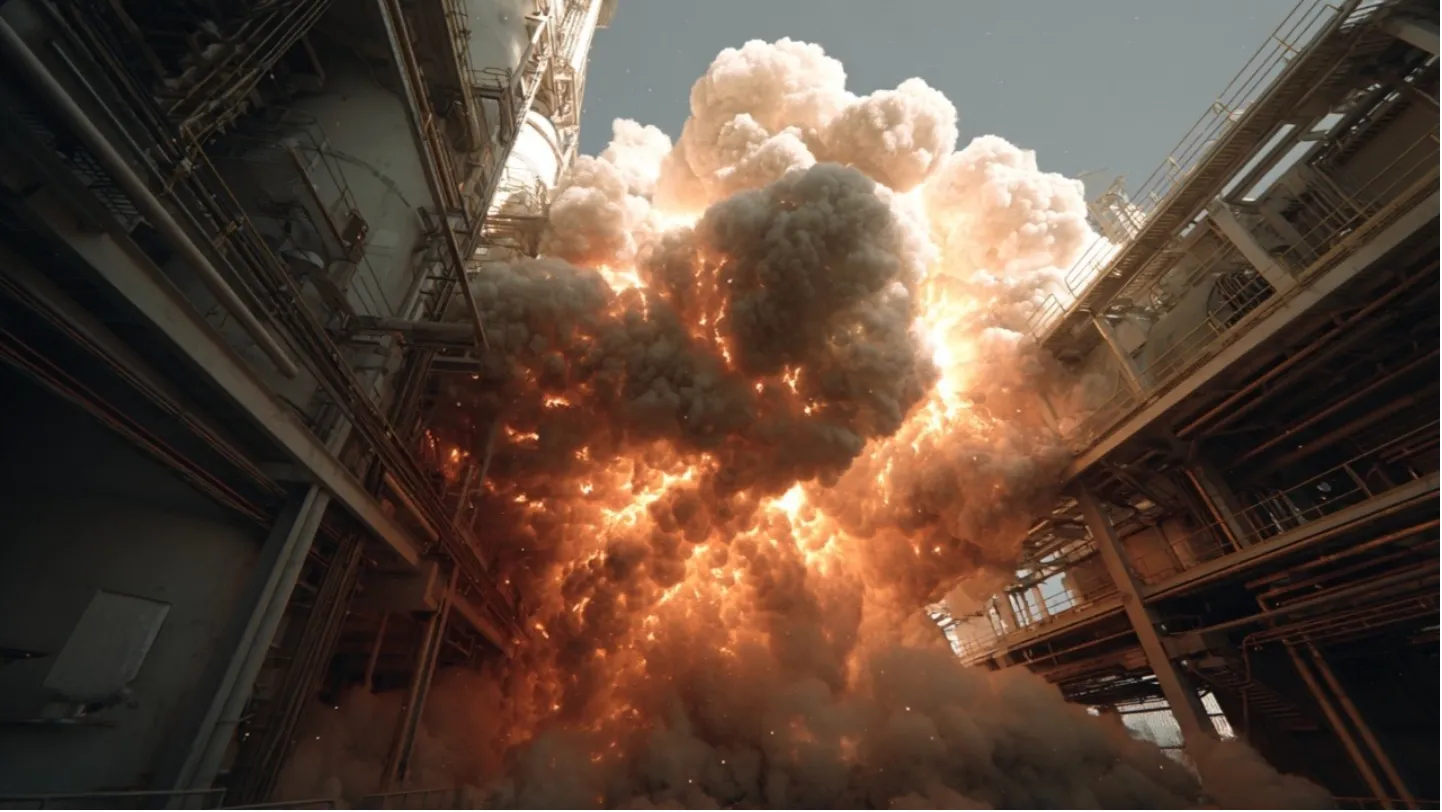
An explosion in Zone 0
Zone 0 means that an explosive gas atmosphere is present continuously, for long periods or frequently. In other words, the presence of the explosive mixture is not a theoretical assumption. It is part of the design basis.
And yet incidents still occur.
When an explosion occurs in Zone 0, the cause is rarely “bad luck”. Zone 0 is based on the principle that ignition sources must be controlled at the highest level. Equipment and protective systems must be suitable for the zone, the gas group, the temperature class, the ambient conditions and the intended mode of operation. For electrical equipment this normally means Equipment Protection Level Ga, for example intrinsically safe Ex ia equipment, or another protection concept that is specifically suitable for Zone 0. The same philosophy applies to non-electrical equipment and mechanical ignition sources: the equipment must not become an effective ignition source, including under fault conditions that are relevant for the required protection level.
If an explosion still occurs, something fundamental has been broken.
It may be a modification that was never fully reassessed. It may be the replacement of a component that appeared equivalent but was not equivalent in its ignition-source behaviour. It may be an earthing or bonding connection that was assumed to be continuous but failed in practice. It may be a process deviation outside the original design philosophy. Or it may simply be a set of assumptions that gradually became accepted without being challenged again.
Zone 0 does not forgive optimism.
There is no safety margin based on the hope that the explosive atmosphere will not be present. It is already expected to be present. The safety concept therefore depends on the prevention of effective ignition sources, the correct selection and installation of equipment, the control of electrostatic and mechanical ignition hazards, and the continued validity of the original risk assessment.
That is why Zone 0 must be treated as a system issue, not merely as a certification issue.
Under the European ATEX workplace framework, employers must assess explosion risks, classify hazardous areas, define protective measures and keep an Explosion Protection Document. Equipment placed on the EU market must meet the requirements of ATEX Directive 2014/34/EU. In the United Kingdom, the same operational risk principle is reflected in DSEAR, while equipment and protective systems are addressed through the UK Equipment and Protective Systems Intended for Use in Potentially Explosive Atmospheres Regulations.
The technical foundation is found in standards such as EN/IEC 60079-10-1 for area classification, EN/IEC 60079-11 for intrinsic safety, EN/IEC 60079-14 for design, selection and installation, EN/IEC 60079-17 for inspection and maintenance, and EN 1127-1 for ignition hazard assessment and explosion prevention.
What makes an explosion in Zone 0 so confronting is that it rarely points to one isolated failure. Design, installation, operation, maintenance, modification control and supervision all meet at this point. It is almost never just one screw, one cable gland or one instrument that explains the event. It is the loss of coherence between the assumptions, the equipment, the process and the way the installation is actually operated.
The uncomfortable question after such an incident is therefore not:
“Which component failed?”
The real question is:
“Which assumptions became normal without being verified again?”
In Zone 0, safety is not a statistical comfort zone.
It is a strict design requirement.
And strict design requirements leave no room for complacency.
https://exquintia.com/
#ATEX #DSEAR #UKEX #ExplosionSafety #Zone0 #ProcessSafety #IntrinsicSafety #IEC60079 #EN1127 #HazardousAreas #RiskAssessment #Engineering #IndustrialSafety #AssetIntegrity #Exquintia