
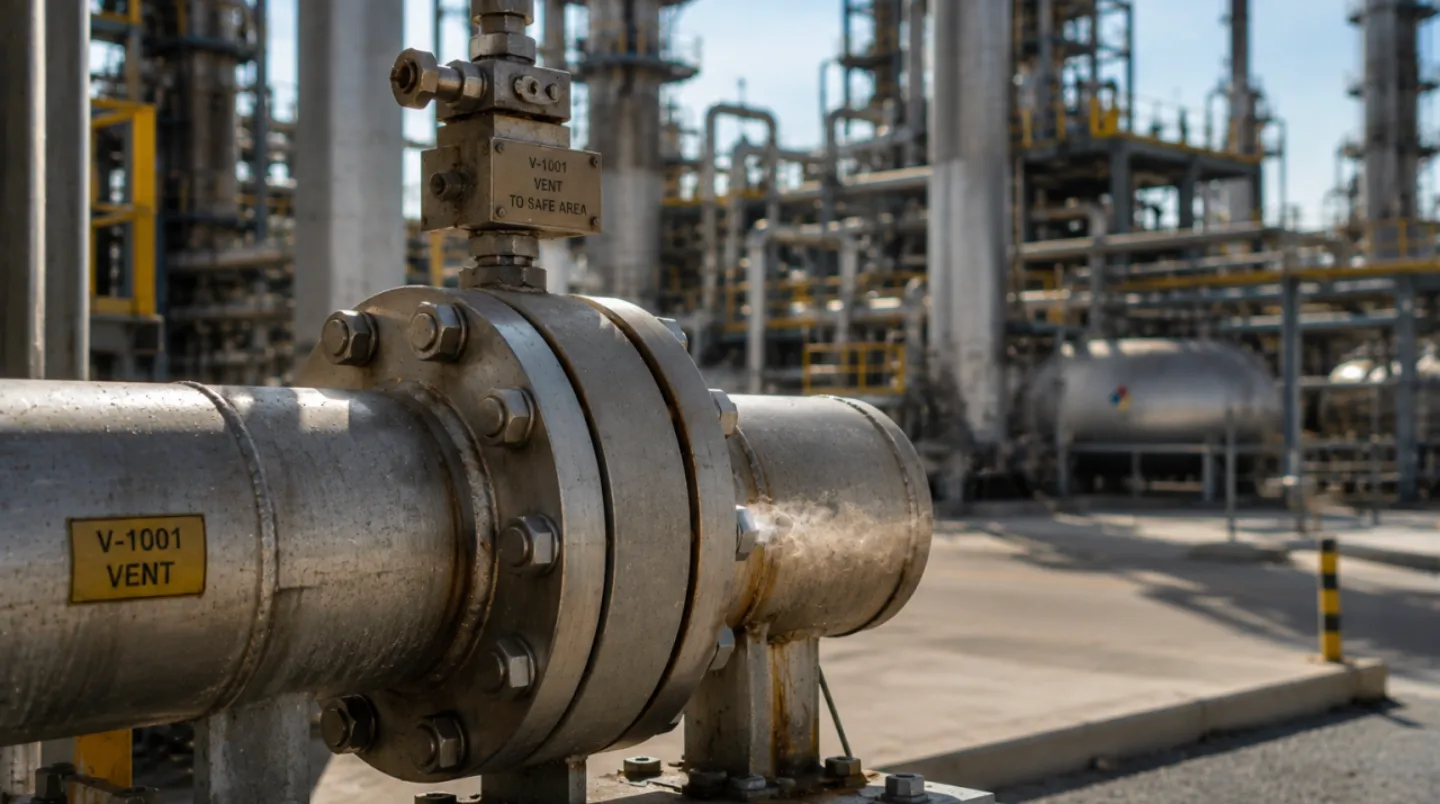
The most expensive ATEX mistake is often not shown on the hazardous area drawing
When ATEX is discussed, attention usually goes to zones, equipment certification and inspections. These are visible parts of explosion safety, and they are important. But the basis of every hazardous area classification is established much earlier.
In almost every explosion risk assessment, the first question should be:
Where is the source of release?
An explosive atmosphere does not appear by itself. A flammable gas, vapour, mist or combustible dust must first be released. Only then can it be assessed whether an explosive atmosphere can form, how often it may occur, how long it may persist and which hazardous area classification is appropriate.
This is where some of the most costly mistakes are made in practice.
A vent, filling point, sampling point, manway, flange connection, overflow, filter discharge or transfer point may be a source of release. The assessment of that source ultimately determines the extent of the hazardous area, the required Equipment Protection Level, the suitability of installed equipment, the maintenance strategy and sometimes even the investment cost of an entire project.
Under the ATEX workplace framework in Europe, this assessment must be part of the explosion risk assessment and the Explosion Protection Document. In the United Kingdom, the same principle applies through DSEAR, where employers must assess risks from dangerous substances, prevent or control explosive atmospheres and classify hazardous places where required.
For gases and vapours, IEC/EN IEC 60079-10-1 provides the technical framework for hazardous area classification. For combustible dusts, IEC/EN IEC 60079-10-2 provides the corresponding framework. Both standards make clear that classification is not a drawing exercise. It is a technical assessment based on sources of release, release frequency, release duration, ventilation, dilution, material properties and operating conditions.
Within hazardous area classification, sources of release are commonly considered as continuous, primary or secondary. A continuous source of release gives rise to a release continuously, for long periods or frequently. A primary source of release is expected to release during normal operation. A secondary source of release is not expected to release during normal operation and, if it occurs, is expected to do so only infrequently and for short periods, for example due to abnormal conditions, wear, leakage or failure.
A second question is just as important:
Is the release limited or not effectively limited?
A limited release may be restricted by a small opening, a controlled leak path or a defined process condition. In such cases the quantity of flammable gas, vapour, mist or combustible dust released may be relatively small. With an unrestricted or poorly defined release, the quantity released can be significantly larger. That directly affects the extent, duration and severity of the hazardous area.
The consequences of a wrong assessment often become visible only years later.
An installation may be fitted with unnecessarily expensive explosion-protected equipment because the source of release was overestimated. But the opposite also occurs. An underestimated source of release can lead to an area classification that is too limited, allowing potential ignition sources to remain present in a risk area without being recognised.
That is why explosion safety does not begin with the question:
Which zone is present here?
The first question should always be:
Which source of release forms the basis of this zone, and has it been assessed correctly?
A hazardous area drawing is ultimately only the result of an analysis.
The quality of that analysis is determined by the quality of the source of release assessment.
That is where explosion safety begins.
https://exquintia.com/
#ATEX #DSEAR #ExplosionSafety #ProcessSafety #HazardousAreas #IEC60079 #IECEx #RiskAssessment #AssetIntegrity #Engineering #IndustrialSafety #ChemicalIndustry #FoodIndustry #Maintenance #Inspection #SafetyCulture #Exquintia