
The risk is not always where we expect it
In explosion safety, we often focus on the familiar sources of risk: solvents, gas lines, tank vents, powder handling systems, process vessels and traditional lead-acid battery charging rooms.
However, modern industrial technology introduces new blind spots.
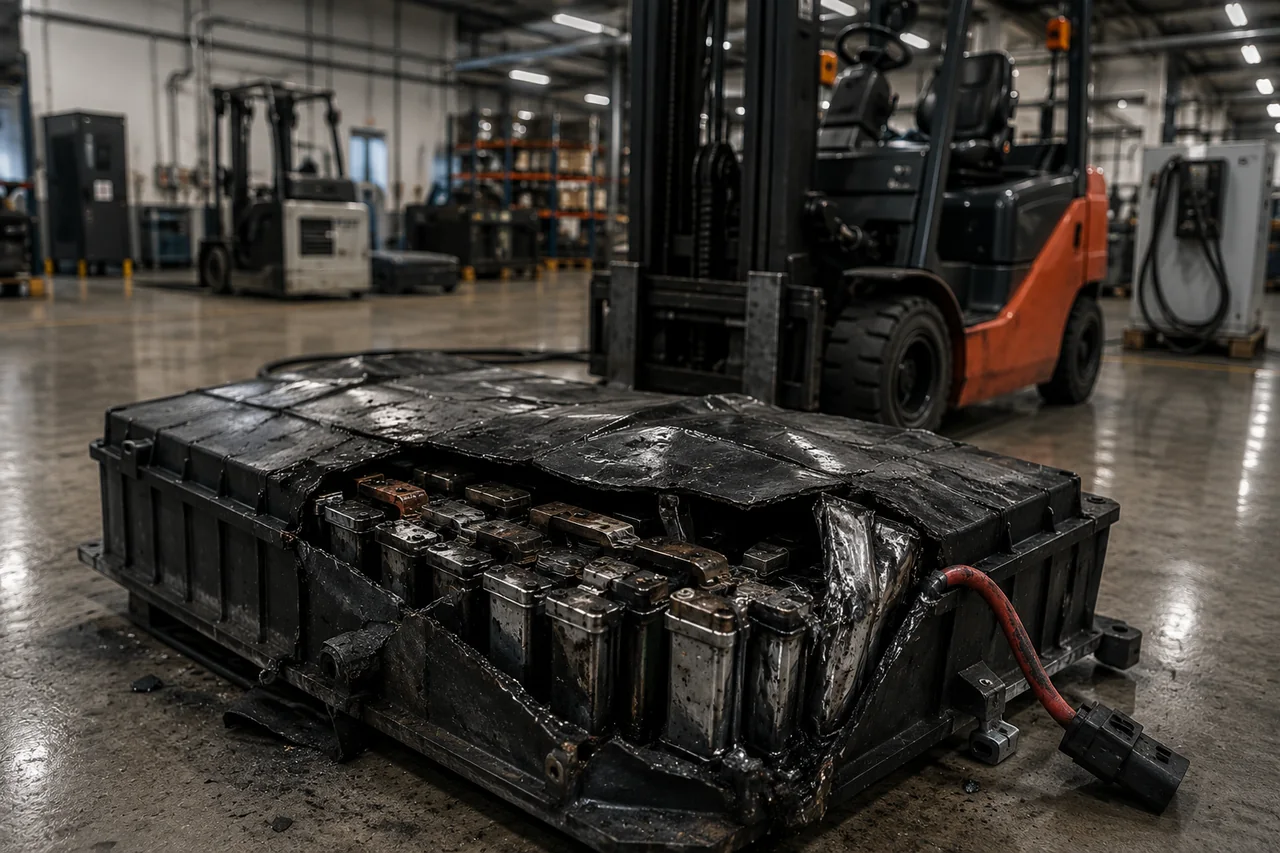
One example is the use of lithium-ion batteries in forklifts, AGVs, pallet trucks, power tools, UPS systems and mobile energy storage units. The main risk is not automatically the creation of a hazardous area during charging. In many cases, the more critical scenario starts with a mechanical event.
A battery pack is struck by a forklift fork.
A module is dropped.
A housing is crushed.
A cell is deformed or penetrated.
Afterwards, the battery may still appear usable.
Internally, however, the separator may have been damaged. This can lead to a delayed internal short circuit. The cell heats up, gases may be released, and thermal runaway can develop.
Not always immediately.
Not always visibly.
Not always when people are still watching.
That is what makes this scenario so dangerous.
The lesson is not to classify every lithium battery charging location as a hazardous area by default. The lesson is to assess battery safety more broadly: impact damage, deformation, storage of damaged batteries, quarantine areas, ventilation, detection, instruction, maintenance and emergency response should all be part of the risk assessment.
In an international context, this belongs within the employer’s duty to perform a suitable and sufficient risk assessment under occupational health and safety legislation. Where explosive atmospheres may occur, the assessment should be aligned with recognised explosion protection principles such as ATEX in the European Union, IECEx for international certification practice, and the IEC 60079 series for classification, equipment selection, installation, inspection and maintenance.
For lithium-ion batteries, however, the primary concern is often not classical hazardous area classification. It is the fire, gas release and escalation scenario after mechanical, thermal or electrical abuse.
Sometimes a serious event does not begin with a process failure.
It begins with damage that looked too small to investigate.
That is exactly where the blind spot starts.
#LithiumIonBatteries #ThermalRunaway #BatterySafety #ExplosionProtection #ATEX #IECEx #ProcessSafety #Forklifts #IndustrialSafety
Sources
IECEx – International system for certification to standards relating to equipment for use in explosive atmospheres.
European Commission – ATEX Directive 2014/34/EU for equipment and protective systems intended for use in potentially explosive atmospheres.
IEC 60079 series – International standards for explosive atmospheres, including hazardous area classification, equipment protection, installation, inspection and maintenance.
OSHA – Lithium-ion battery safety guidance, including warning signs such as temperature rise, venting, smoke and gas release.
NFPA – Lithium-ion battery and energy storage safety information, including thermal runaway, fire and explosion risk.
NFPA 855 – Standard for the Installation of Stationary Energy Storage Systems, relevant for larger battery energy storage applications.
De inhoud blijft bewust weg van de onjuiste stelling dat lithium-forklift charging automatisch een hazardous area oplevert. IECEx is het internationale certificatiesysteem voor apparatuur in explosieve atmosferen, ATEX 2014/34/EU geldt voor apparatuur en beveiligingssystemen binnen de EU, en IECEx verwijst naar de IEC 60079-reeks voor onder andere area classification, equipment protection, installation, inspection and maintenance. OSHA en NFPA ondersteunen de batterijveiligheidslijn: lithium-ion incidenten kunnen gepaard gaan met thermal runaway, gasvorming, rook, brand of explosierisico.