
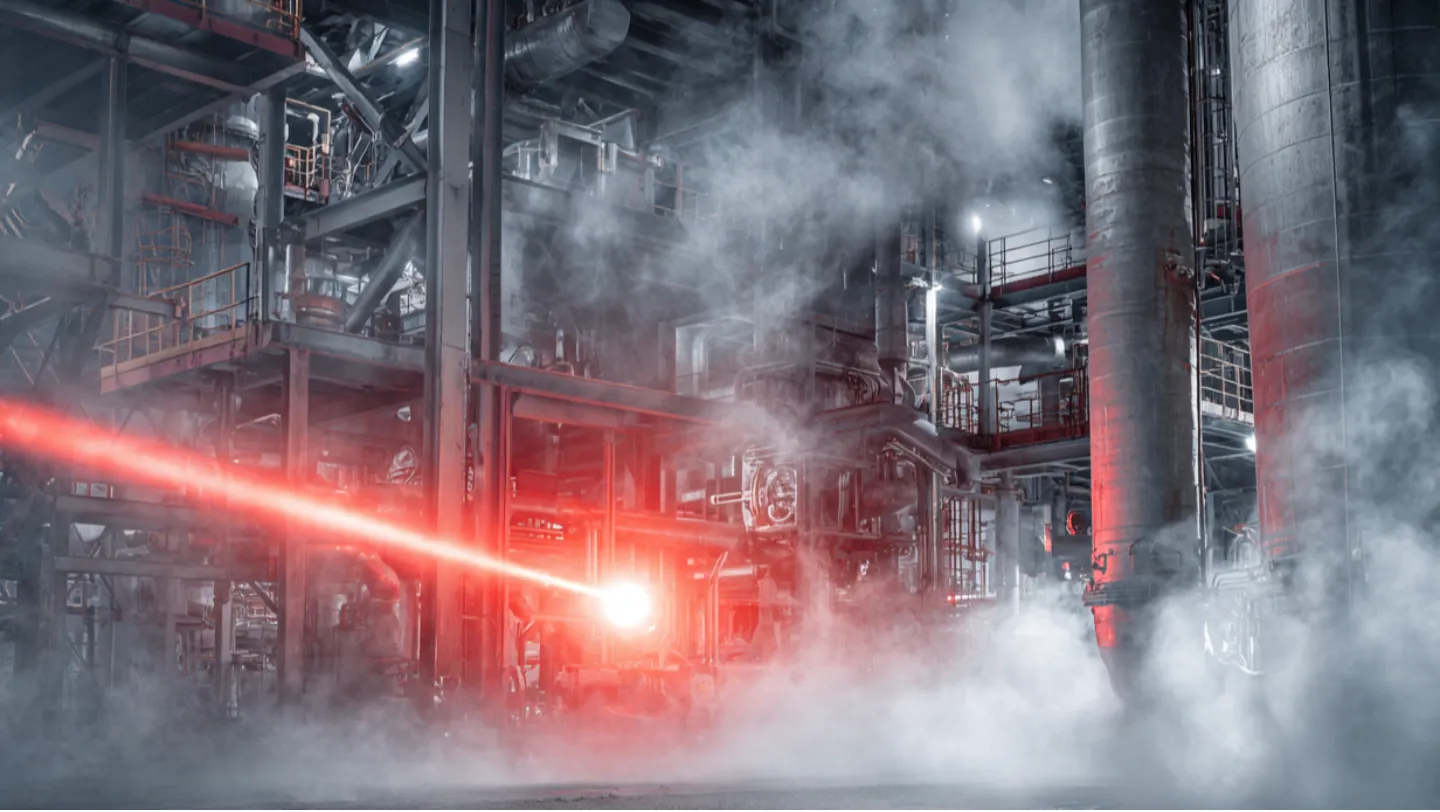
The new reality under EN IEC 60079-28: optical radiation as an ignition source
In many industrial installations, potential ignition sources are still associated first with electrical sparks, hot surfaces or mechanical friction. That is understandable, but it is no longer sufficient. Process technology is changing rapidly. Laser-based measurement systems, optical sensors, fibre-optic communication and optical analysers are increasingly being used in process plants, tank farms, hydrogen installations, refineries and chemical production facilities.
That development raises a less familiar, but very real question:
Can light cause an explosion?
The answer is yes, under the right conditions it can.
For Europe, this subject sits within the wider framework of the ATEX Workplace Directive 1999/92/EC, the ATEX Equipment Directive 2014/34/EU and the harmonised EN/IEC 60079 series. In the United Kingdom, the same operational issue must be addressed under DSEAR 2002 for workplaces and under the Equipment and Protective Systems Intended for Use in Potentially Explosive Atmospheres Regulations 2016 for equipment placed on the GB market. The technical assessment is then supported by standards such as EN IEC 60079-0 and EN IEC 60079-28.
EN IEC 60079-28 deals with equipment, associated equipment and Ex components containing optical systems that emit optical radiation and may be exposed to explosive atmospheres. It addresses optical radiation in the wavelength range from 380 nm to 10 µm. That includes visible light, infrared radiation and part of the near-ultraviolet boundary region.
The hazard is not simply that light is present. The hazard is what optical energy can do when it is concentrated, absorbed or focused in a hazardous area.
There are three ignition mechanisms that deserve particular attention.
The first mechanism is heating by absorption. When optical radiation is absorbed by a surface, dust particle or deposit, local heating can occur. If the energy density is high enough, the temperature of that material can rise to a level capable of igniting a surrounding gas, vapour or dust atmosphere. This can be relevant for high-power laser beams, concentrated light beams, optical measurement instruments and systems with defined focal points inside a hazardous area.
The second mechanism is laser-induced gas breakdown. In exceptional cases, a sufficiently powerful laser beam can ionise the gas itself. Plasma and a shock wave may then be formed at the focal point, both of which can act as ignition sources. The risk can increase when a solid surface is located close to the breakdown point.
The third mechanism is focusing within optical systems. An optical system that converts light into a convergent beam can create very high energy density at the focal point. In a hazardous area, such a focal point must not be treated as a harmless feature of the instrument. It may become part of the ignition source assessment.
This is relevant for systems such as laser equipment, optical fibre equipment, spectroscopic gas analysers, optical level measurement, laser distance measurement, fibre-optic temperature systems and optical process analysers. These technologies are increasingly used because they are accurate, fast, suitable for long distances and often attractive in environments where conventional electrical signals are less desirable.
But they also introduce an ignition source category that is not always recognised in traditional ATEX or DSEAR assessments.
Not every optical system automatically creates an unacceptable risk. Class 1 lasers in accordance with IEC 60825-1 are normally outside the scope for many EPL applications because their optical energy is limited. Passive optical fibre cables are not normally considered ignition sources when they are not part of active optical equipment and are installed and mechanically protected according to appropriate industrial practice. Optical radiation that is fully contained within a suitable Ex enclosure can also be controlled, for example by flameproof enclosure “d”, pressurisation “p”, restricted breathing “nR” or dust protection by enclosure “t”, provided the protection concept is suitable for the required EPL and the installation conditions.
The important point is that EN IEC 60079-28 is not a stand-alone replacement for the rest of the explosion protection assessment. It is an additional standard to be read alongside EN IEC 60079-0 and the wider EN/IEC 60079 series. Where optical radiation is present in or near a hazardous area, the ignition source analysis must include optical power, irradiance, energy density, beam path, absorption by surfaces or dust deposits, focal points, laser class, foreseeable faults and the Equipment Protection Level required by the hazardous area classification.
This is where the European and UK legal frameworks meet the technical reality. ATEX and DSEAR require the employer or operator to identify where explosive atmospheres may occur and to prevent effective ignition sources. Equipment compliance alone is not enough if the actual installation creates a focusing point, absorption surface or operating condition that was not considered in the risk assessment.
Optical technology often appears safe because there is no visible electrical spark. In reality, light can transfer energy with extreme precision. Under the wrong conditions, that energy can become an ignition source.
The question for modern process plants is therefore not only:
“Is this instrument certified for the hazardous area?”
The better question is:
“Has the optical radiation itself been assessed as a possible ignition source under the real installation and process conditions?”
That is the new reality of explosion protection.
https://exquintia.com/
#ATEX #DSEAR #ExplosionProtection #OpticalRadiation #IEC60079 #IEC6007928 #ProcessSafety #HazardousAreas #IgnitionSourceAnalysis #LaserSafety #FibreOptics #ChemicalIndustry #HydrogenSafety #IndustrialSafety #Exquintia