
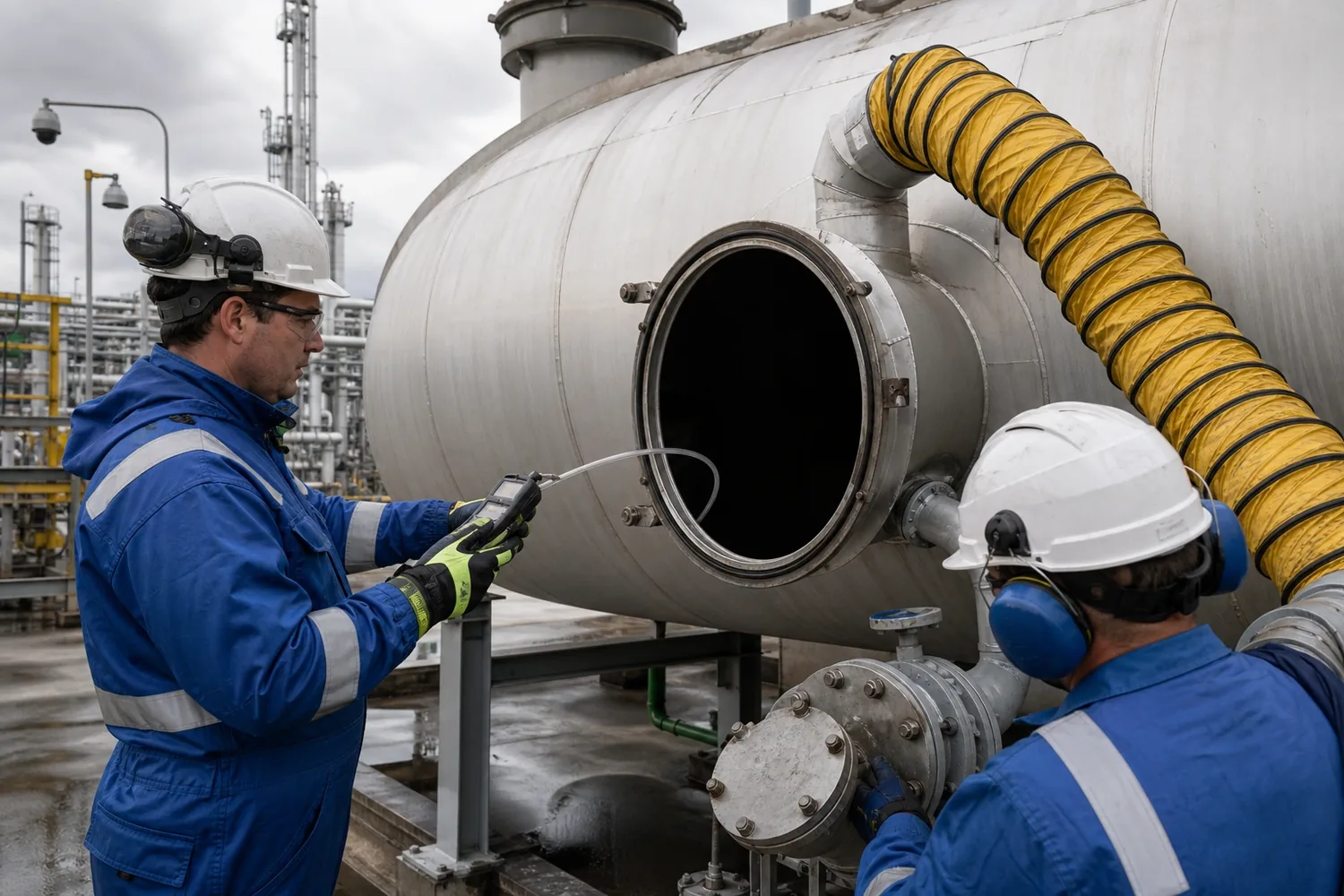
The tank is empty and out of service. Why can it be more dangerous now?
“The tank is empty. We are only opening it for maintenance.”
Empty is a process condition. Gas-free is a measured condition.
After draining, flammable vapour can remain in the headspace, sludge, product residues, seals or porous deposits. Opening and cleaning may release more material. At the same time, air enters, inerting may be lost and the concentration can pass through the flammable range. A tank that was safely inert during operation may therefore become more hazardous during its transition to maintenance.
The ignition picture changes too. Temporary electrical equipment, static discharge, grinding or welding, and even an unsuitable detector can introduce ignition sources that were absent in normal service. Shutdown is not a pause in explosion protection; it is a separate operating condition that needs its own assessment.
ATEX Workplace Directive 1999/92/EC requires employers to assess the likelihood and persistence of explosive atmospheres, ignition sources, installations, substances, processes and the scale of anticipated effects. Its prevention hierarchy starts with preventing explosive atmospheres, then avoiding ignition, then mitigating detrimental effects. It also requires written instructions and a permit-to-work system for hazardous activities where the explosion protection document identifies the need. National transposing law may add more detailed confined-space and inspection requirements.
For tank maintenance, the evidence chain starts with positive isolation. The contents and possible residues must be understood, followed by a suitable combination of draining, cleaning, purging, ventilation or inerting. Atmospheric testing should then cover oxygen, flammable components and relevant toxic substances at representative locations. A single reading at the manway does not prove that low points, internals and dead spaces are safe, or that conditions will remain stable. Repeated or continuous monitoring may be needed as work and ventilation change.
Only when the risk assessment, isolations, testing strategy, work permit, supervision and emergency arrangements agree should the task be released. Applicable limits and testing frequency depend on the substances, work method, national rules and site procedure; there is no universal number for every tank.
Everyone respects the hazard of a tank full of product. The dangerous shortcut is assuming that empty means safe.
Where does your procedure draw the documented line between “empty”, “tested” and “released for work”?